
Pursuant to Republic Act No. 10689, the 11th National Indigenous Peoples Day is observed today, August 9, as many communities across the country honor Indigenous Peoples (IP) through ceremonies, cultural presentations, and tributes to heritage that has survived generations of change. Yet beyond these are deeper narratives unfolding inside classrooms—stories that rarely make headlines but perhaps say more about the future of Indigenous communities than any ceremonial speech ever could.
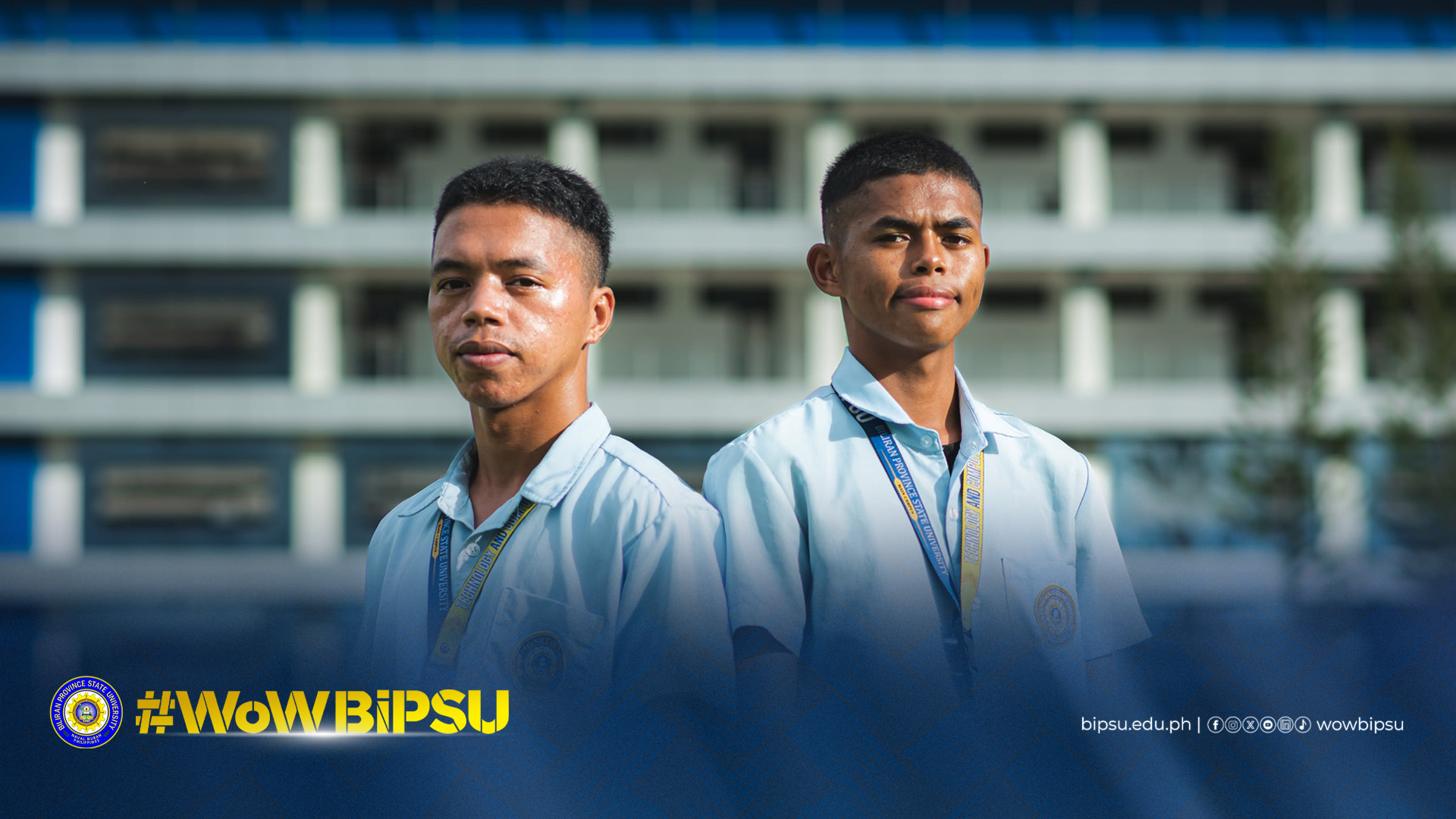
Inside Biliran Province State University (BiPSU), two young men from the Mamanwa tribe are writing one of those stories.
Joshua Paradas and his cousin Jason Paradas, both second-year Bachelor of Science in Information Science (BSIS) students under the School of Technology and Computer Studies (STCS), are proving that higher education is not simply changing individual lives; it is slowly changing the story of an entire tribe.
Raised in the province’s Cabibihan, Caibiran, the cousins grew up where days revolved around farming, harvests, and the uncertainty of whether the next season would provide enough. Their parents tilled the land for a living, and like many Indigenous families, education beyond high school was once considered a privilege rather than an expectation.
Today, both wear university uniforms instead of work clothes, balancing programming classes, laboratory activities, and Reserve Officers' Training Corps (ROTC) responsibilities while carrying with them something far greater than academic requirements—the hopes of a tribe that is gradually discovering that college, too, can belong to them.
A family's first footsteps
Joshua's story began before he even entered college. His older brother, John Paradas, became one of the pioneering beneficiaries of BiPSU's Affirmative Action Scholarship Program for Indigenous Peoples and graduated in 2025 as the first college graduate in their family. For most families, one diploma is a personal achievement; for the Paradas family, it became permission to dream.
Seeing his brother finish college transformed what once seemed impossible into something attainable. Joshua eventually became the third member of their family to pursue higher education.
Yet the journey was never easy.
He had originally dreamed of taking a Bachelor of Science in Criminology, hoping one day to serve in uniform. But admission requirements demanded expenses his family simply could not afford at the time. Without the financial means to process all the documentary requirements, he reluctantly chose BSIS instead.
Sometimes, destiny begins not with the course we wanted, but with the opportunity that remains open.
This time, Joshua no longer sees BSIS as a second choice. He now dreams of becoming an Information Systems Analyst in the Philippine Navy, combining technology with public service in ways he never imagined when he first entered the university.
Meanwhile, Jason walked a remarkably similar road. He, too, dreamed of becoming a police officer. He, too, hoped to enroll in Criminology. And he, too, found himself redirected toward BSIS by financial realities.
Unlike Joshua, however, Jason carries another distinction. He is the very first college student in his family. Every examination he passes, every programming activity he submits, every semester he completes represents something no one in his household had accomplished before. His education is not merely personal achievement, but the beginning of a new family history.
Bridging the digital divide
The irony of studying Information Systems was not lost on either cousin. They entered a technology program despite having little experience using computers. Growing up, mobile phones were slightly familiar, desktop computers were not. Programming languages, system development, database management, and application design initially felt like unfamiliar worlds.
"Mahirap ang BSIS pero kinakaya," [The BSIS course is difficult, but I strive to manage,] Jason admitted. Their greatest classroom became BiPSU's computer laboratories. There, keyboards gradually replaced uncertainty, coding slowly replaced fear, assignments became opportunities to prove that one's starting point does not determine one's destination.
For many students, computer laboratories are ordinary facilities. For Joshua and Jason, they became spaces where impossible things slowly became familiar.
When opportunity meets the margins
Neither cousin hesitates when asked what made college possible. Both immediately mention the government's Free Higher Education program and BiPSU's Affirmative Action Scholarship. Without free higher education, Jason said, he would never have reached college. "Kung wala ito, hindi ako makakapag-college."
In addition, Joshua shared that the monthly allowance from the University’s scholarship initiative allows him to purchase school supplies, academic requirements, projects, and even everyday necessities.
For farming families whose income depends largely on harvest seasons, those monthly resources mean stability. They mean remaining enrolled when expenses begin piling up. They mean attending class without constantly worrying where tomorrow's allowance will come from.
Their gratitude extends beyond tuition. They believe BiPSU did not merely admit Indigenous students, the institution chose to care for them.
"Hindi kami pinabayaan, inalagaan kami," [We were not neglected, we were taken care of,] they stated.
Their story demonstrates how public education policies become transformative when they reach real people. In Joshua and Jason's lives, the Free Higher Education Law is no longer policy statements printed in government documents, but they have become notebooks purchased, meals provided, projects completed, semesters finished, and dreams sustained.
Supported by the Commission on Higher Education (CHED), these initiatives have enabled Indigenous learners not only to enter universities but to remain in them, reinforcing that quality higher education should be accessible regardless of economic status or cultural background.
Finding dignity in the classroom
If financial hardship challenged their education, discrimination challenged their identity.
Joshua recalls high school as a place where being Mamanwa often made him the subject of ridicule. His skin color became an easy target, the teasing was constant enough that it quietly changed how he viewed himself. There was a time when he felt embarrassed simply because he belonged to an Indigenous community.
College changed that.
"In BiPSU, students respect one another," he shared. Instead of judgment, he found acceptance. Instead of shame, he found confidence. Instead of hiding his identity, he slowly learned to embrace it.
He credits the institution’s inclusive environment and the support shown by University President Prof. Victor C. Cañezo, Jr. for helping Indigenous students feel valued rather than different. That transformation cannot easily be measured by grades. It is measured by a student finally walking across campus without feeling the need to apologize for who he is.
Proud to be Mamanwa
In the present, Joshua speaks about his identity with a confidence born from experience. He no longer remembers bullying only as pain, instead he remembers it as something that strengthened him.
"Very proud kami," [We’re very proud,] he said. "Special kami dahil hindi kami katulad ng iba," [We are special because we are not like the others.]
Rather than responding with anger, he says the Mamanwa have learned patience, resilience, and understanding. Their strength lies not in fighting back but in continuing forward.
Jason shares the same conviction. He hopes fellow Indigenous youth throughout the country refuse to believe those who tell them they are less capable. Instead, he wants them to remember that IPs are unique because they continue to preserve cultures and traditions that have existed long before modern society.
He also worries about the future of their tribe. As younger generations marry outside their Indigenous communities, he fears that Mamanwa identity could slowly disappear. For him, education is not only about professional success; it is also about preserving culture, protecting identity, and ensuring that future generations continue telling the story of who they are.
A chance their parents never had
Their parents knew hard work long before they knew opportunity.
The farm had always been the family's classroom. Seasons dictated income. Harvests decided whether there would be enough for tomorrow. Like many Indigenous parents, they dreamed of sending their children to college, yet understood that dreams alone could not pay tuition. Mayhaps that is why Joshua and Jason never speak of education as something they achieved by themselves, they speak first of the opportunities that reached them.
The Universal Access to Quality Tertiary Education Act (RA 10931), implemented through state universities such as BiPSU, removed one of the heaviest burdens their families carried. Complemented by the University's Affirmative Action Scholarship program for Indigenous Peoples, the support allowed them to stay in school, purchase academic needs, and continue learning without asking their parents to bear what they could no longer afford.
Sometimes, the greatest gift education gives is the relief it brings to parents who no longer have to choose between sending a child to school or putting food on the table.
Dreams that return home
When asked about life after graduation, neither cousin immediately speaks about salary, prestige, or personal success. Instead, both return to their community.
Joshua hopes to secure meaningful employment and become an inspiration for younger Mamanwa children who are still unsure whether college is meant for them. He dreams that one day, Indigenous students will pursue higher education not to prove their worth to others, but because they already believe in themselves.
Jason envisions helping fellow tribe members through simple but meaningful acts—providing school supplies, groceries, food, and other necessities whenever possible. He also uses social media and vlogging to introduce people to Mamanwa culture, believing that visibility is one way of preserving identity.
Their message to fellow Indigenous youth echoes throughout the interview. “Study, have faith in yourself, do not surrender to discrimination, finish college, return home, share what you have learned.”
Because education, they believe, should never end with one diploma. It should become something passed from one generation to another.
A future rewritten
Joshua and Jason are not extraordinary because they escaped hardship. They are extraordinary because they chose not to allow hardship to define the limits of their future. Their story reflects what becomes possible when government support, inclusive education, and personal determination meet at the same point.
Through CHED's Free Higher Education program and BiPSU's continuing commitment to Indigenous inclusion, opportunities once reserved for only a few have begun reaching communities long placed at society's margins.
As the nation celebrates National Indigenous Peoples Day, their journey reminds Filipinos that honoring Indigenous communities extends far beyond cultural performances or annual commemorations; it means ensuring that Indigenous learners are welcomed inside classrooms, respected for who they are, supported in their aspirations, and empowered to preserve the very heritage they carry.
Joshua and Jason entered BiPSU hoping to change their own lives. Without perhaps realizing it, they are helping change something much larger. They are showing a younger generation of Mamanwa children that education and cultural identity need not stand on opposite sides of the road, they can walk together.
That is the most enduring lesson their story offers: that the future of IPs will not be secured by preserving traditions alone, nor by pursuing education alone, but by allowing both to grow side by side—where culture remains rooted, opportunity continues to expand, and every Indigenous child can finally believe that the path to college also leads home.
For BiPSU, the true measure of inclusion is not how many Indigenous students enter its gates, but how many leave believing that who they are has always been enough, and that what they have learned can help their communities rise with them.
#WoWBiPSU
[This article primarily aligns with SDG 4: Quality Education and SDG 10: Reduced Inequalities, while also advancing SDG 1: No Poverty, SDG 16: Peace, Justice and Strong Institutions, and SDG 17: Partnerships for the Goals.]
-
 0
0
-
 6
6
-
 0
0
-
 0
0
-
 0
0
-
 0
0